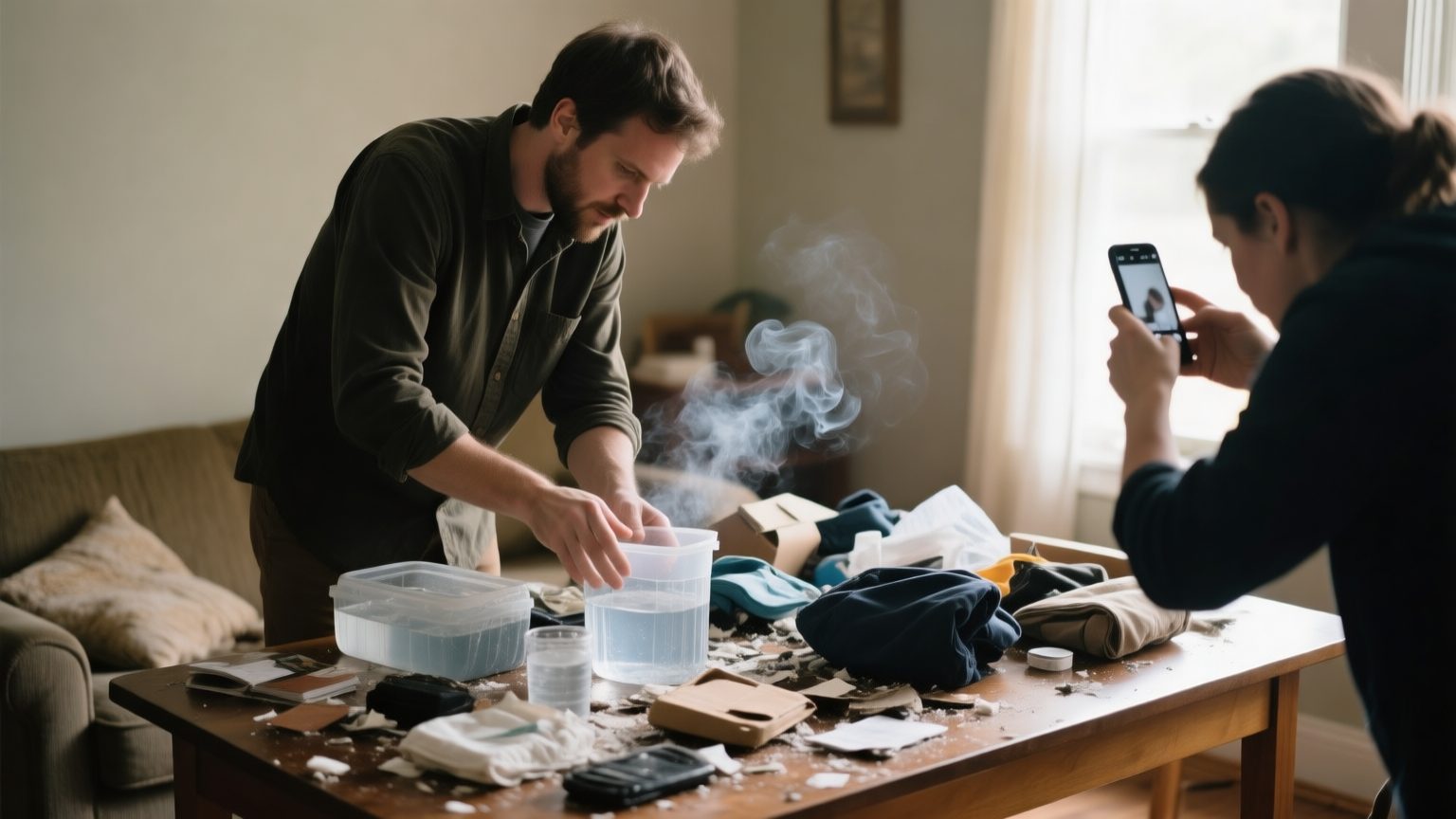
A public adjuster or restoration team handling both water and fire claims quickly learns they are not the same job. The valuation math is the same, replacement cost with depreciation to actual cash value, but what you document, what survives, and what triggers carrier pushback differ sharply between the two. Getting the documentation right for the specific peril is what keeps each claim moving. Here is how water-loss and fire-loss contents claims diverge, and the standard that stays constant across both.
The core difference in one line
Water losses are graded by contamination and moisture. Fire losses are graded by heat, soot, and smoke contamination, and they frequently combine with water damage from firefighting. That means a fire claim usually has more damage categories to assess and document separately, while a water claim turns heavily on how clean the water was and how fast the response happened.
How water-loss contents documentation works
The first question on a water loss is the water category, defined by the IICRC S500 standard for professional water damage restoration. Category 1 is clean water, Category 2 is significantly contaminated, and Category 3 is grossly contaminated, including sewage and rising flood water. The category largely decides restorable versus non-restorable: clean water lets many hard-surface items be dried and saved, while Category 3 typically renders porous contents, soft goods, and particleboard furniture non-restorable because of biohazard exposure.
Time is the second factor. Mold can begin to grow on wet materials within roughly 24 to 48 hours, so documentation has to capture the state of items early, before secondary damage sets in and changes what is restorable. And coverage itself can split: water from a burst pipe is treated differently from rising flood water, which is generally excluded from a homeowners policy and covered, if at all, under separate flood insurance, as the Insurance Information Institute explains in its flood insurance facts. The room-by-room approach to capturing all of this is covered in how to document contents after a water loss.
How fire-loss contents documentation works
Fire is more layered. A single fire claim often carries structural damage, smoke and soot remediation, contents, and additional living expenses as separate components, each with its own documentation. On the contents side, soot and smoke penetrate porous materials such as upholstery, clothing, and bedding, leaving odor and residue that is sometimes reversible through professional cleaning and sometimes not. Electronics exposed to smoke residue carry conductivity and corrosion risks that often make replacement the more defensible call, though that is assessed item by item.
The hardest fire scenario is the total loss, where the item you need to value no longer exists to photograph. Documentation then rebuilds the inventory from memory, room diagrams, pre-loss photos, and any records the homeowner can provide. The method for valuing what burned when nothing is left is the same discipline as documenting contents after a fire, and deciding what makes the non-restorable list is worked through in how the non-restorable list is decided.
Water loss vs fire loss, side by side
| Dimension | Water loss | Fire loss |
|---|---|---|
| Primary grading factor | Water category (clean to grossly contaminated) | Heat, soot, and smoke contamination |
| Restorable vs total loss | Depends heavily on category and speed of response | Depends on soot penetration and odor; electronics often replaced |
| Secondary damage clock | Mold can start in ~24 to 48 hours | Acidic soot keeps degrading materials over time |
| Damage categories on one claim | Often fewer, moisture-focused | Often several: structure, smoke, contents, ALE |
| Documentation challenge | Capturing wet-state condition before it changes | Rebuilding a total-loss inventory with nothing to photograph |
| Coverage wrinkle | Flood water may need separate flood coverage | Fire is broadly covered, but sublimits and proof still apply |
What stays the same across both
Whatever the peril, the valuation standard does not change. Every item still needs a replacement cost value, an age and condition for depreciation, and a source behind the number, so the file holds up in review. That is the replacement cost value standard that governs any contents claim. A line with the item, its price, a source, and its condition is easy for a carrier to accept; a line with a bare number invites a markdown, regardless of whether the cause was water or fire. More guides for each loss type live on the Contensure blog.
How Contensure helps
Contensure works the same way across water and fire losses: it turns your photos, item lists, spreadsheets, and claim files into review-ready item descriptions and replacement cost values with the evidence attached, so a large or messy inventory is drafted in minutes instead of days. It complements your restoration and packout workflow rather than replacing it, and it keeps professionals in control: AI drafts the valuation and the evidence, your team reviews and signs off. Claim data is handled carefully, and you can read how Contensure handles security. To try it on a water or fire claim, talk to the Contensure team. This is informational, not legal or insurance advice.