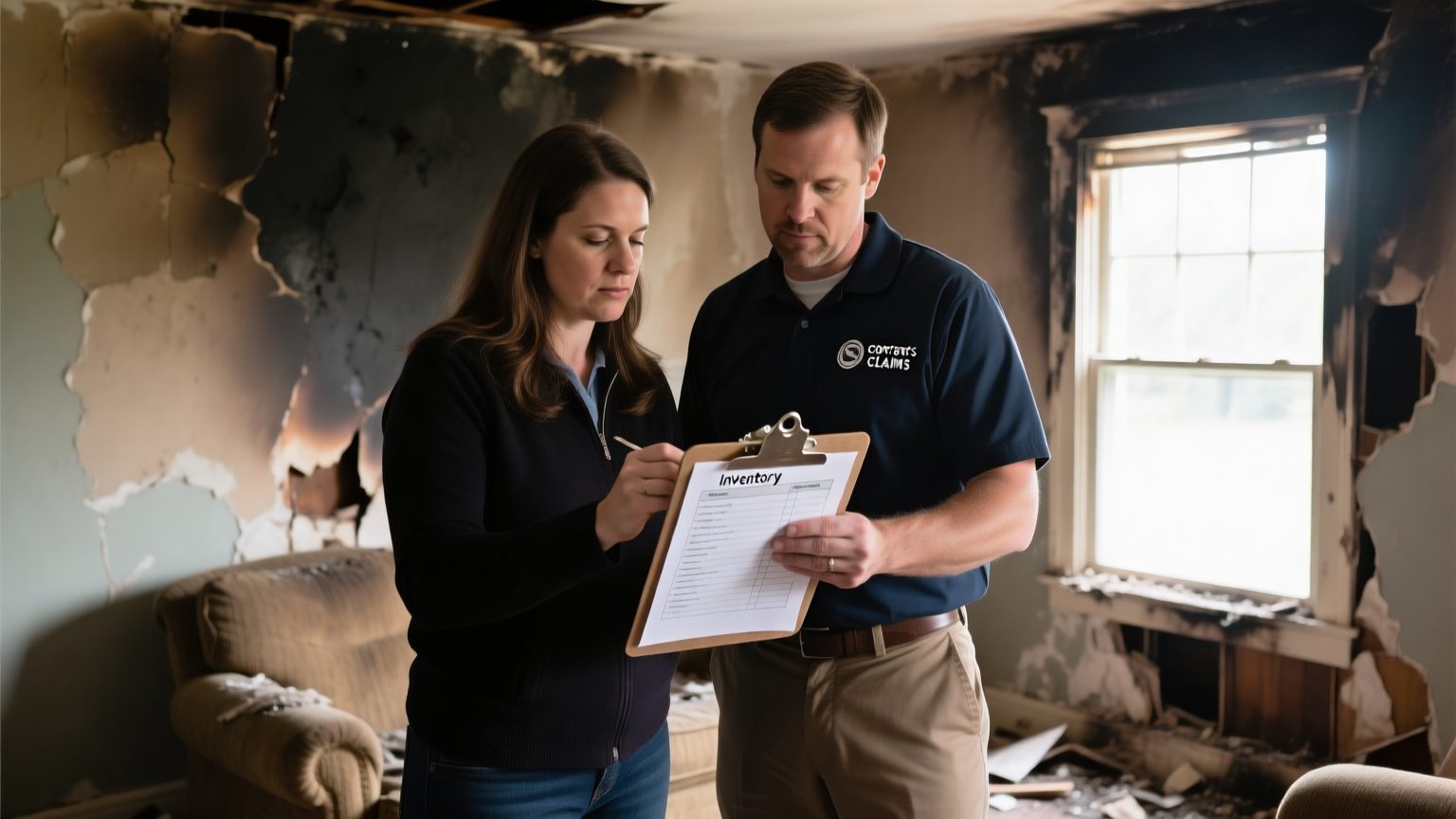
Why a total loss is a documentation problem, not a valuation problem
On a normal contents claim, you can walk the property, photograph a damaged television, and price its replacement. After a fire that consumes a home, the hard part is not deciding what a television costs. It is proving the television existed at all. The evidence you would normally photograph has burned with everything else, and the claim now depends on reconstructing a list of things that are no longer there.
That reconstruction is the whole job. The insured generally carries the burden of documenting what was lost and what it was worth, and a carrier can only pay for items it can see supported. A number with no item behind it and no evidence attached is easy to question. A reconstructed inventory where each line has a description, a source, and a defensible value is what keeps a total-loss claim moving. This is why fire losses live or die on documentation, and why the memory-and-records phase matters more than the pricing that follows it. For the underlying definition of the value you are building toward, see what replacement cost value (RCV) means.
Rebuild the inventory room by room
The most reliable way to remember a house full of belongings is to walk it in your mind one room at a time, because recall is spatial. Start at the front door and move through each room, listing what was on every wall, shelf, and closet. Do not try to remember the whole house at once; you will miss half of it. The Insurance Information Institute's guidance on how to create a home inventory follows the same room-by-room logic, and the reverse process works after a loss.
Then corroborate the memory with records that survived because they were never in the house:
- Bank and credit card statements, which show past purchases by merchant and amount.
- Email receipts and order histories from online retailers.
- Photos and videos backed up to a phone or cloud account, including background details in old pictures that show items in a room.
- Delivery records, warranties, and owner's manuals stored digitally.
- Social media posts that happen to show possessions.
These sources do two things at once: they jog memory about items you would otherwise forget, and they become the evidence that supports the value later. The step-by-step version of pulling this together after a fire is covered in how to document contents after a fire.
Value each item at replacement cost for like kind and quality
Once the list exists, each item needs a replacement cost value: the price to buy the same item new today. When the exact model is discontinued, which is common for anything more than a few years old, you value a comparable item of like kind and quality, meaning similar type, features, and grade. You are not upgrading to a better model and you are not guessing low; you are finding the honest current price of an equivalent.
Replacement cost is the starting figure. Many policies pay actual cash value first, which is replacement cost minus depreciation for age and condition, then release the remaining recoverable depreciation after the item is actually replaced and proof is submitted. The exact mechanics of what is paid and when are set by your policy, not by any rule of thumb, so your policy language governs.
Attach evidence to every value
A defensible inventory is one where every value can be traced back to something. For each line item, that means a clear description, a price from a reputable retailer or a documented comparable, and the source recorded next to the number. The table below ranks the evidence types a reconstructed fire inventory typically relies on.
| Evidence type | What it supports | Strength |
|---|---|---|
| Original receipt or order record | Item existed, original price, model | Strongest |
| Bank or card statement line | A purchase of that amount at that merchant | Strong |
| Pre-loss photo or video showing the item | Item existed and its condition | Strong |
| Current retailer price for the same or comparable item | Replacement cost, like kind and quality | Strong for value |
| Owner recollection alone | Item existed | Weakest; corroborate where possible |
The goal is not to make the claim bigger. It is to make each value reviewable, so the file moves through carrier review instead of stalling on questions. Building the file this way from the start is the subject of building an audit-ready contents file, and it is the same evidence a proof of loss will rest on.
The proof of loss brings it together
Most policies require a proof of loss: a signed, often sworn statement listing the damaged and destroyed property and the amount claimed, submitted within a deadline set by the policy or state law. The reconstructed inventory, with its values and evidence, is what populates that document. Missing the deadline or submitting an unsupported list is where fire claims commonly stall, so treat the inventory as the working file that feeds the proof of loss, not a separate task. The general claims sequence is outlined in the Insurance Information Institute's overview of how to file a homeowners claim, and the specifics always come from your own policy.
Where AI helps, and where a person must review
Rebuilding and valuing a whole-house inventory by hand is slow, and a large loss can run to thousands of items. This is where AI-powered contents valuation earns its place: it can read the receipts, statements, and partial photos you gathered, draft item descriptions, and propose replacement cost values with the price source attached, in a fraction of the manual time. What it does not do is decide the claim. A professional reviews every item, confirms the like-kind-and-quality match, and signs off before anything is final, because judgment about what existed and what it was worth belongs to a person. AI drafts and documents; professionals review. It complements the adjuster, the restoration team, and estimating tools like Xactimate rather than replacing any of them.
How Contensure helps
Contensure turns messy fire-claim inputs, the photos, receipts, and item lists you were able to gather, into review-ready item descriptions and replacement cost values with the evidence behind each one: the match, the backup data, and the retailer the price came from. It drafts the inventory in a fraction of the manual time, and your team reviews and signs off before anything is submitted. Uploaded claim files are handled securely. Contensure assists with identification, valuation, and documentation; it does not replace professional judgment, it is not a public adjuster, and it does not promise a particular payout. More guides are on the Contensure blog, and you can talk to Contensure about large-loss and total-loss work.