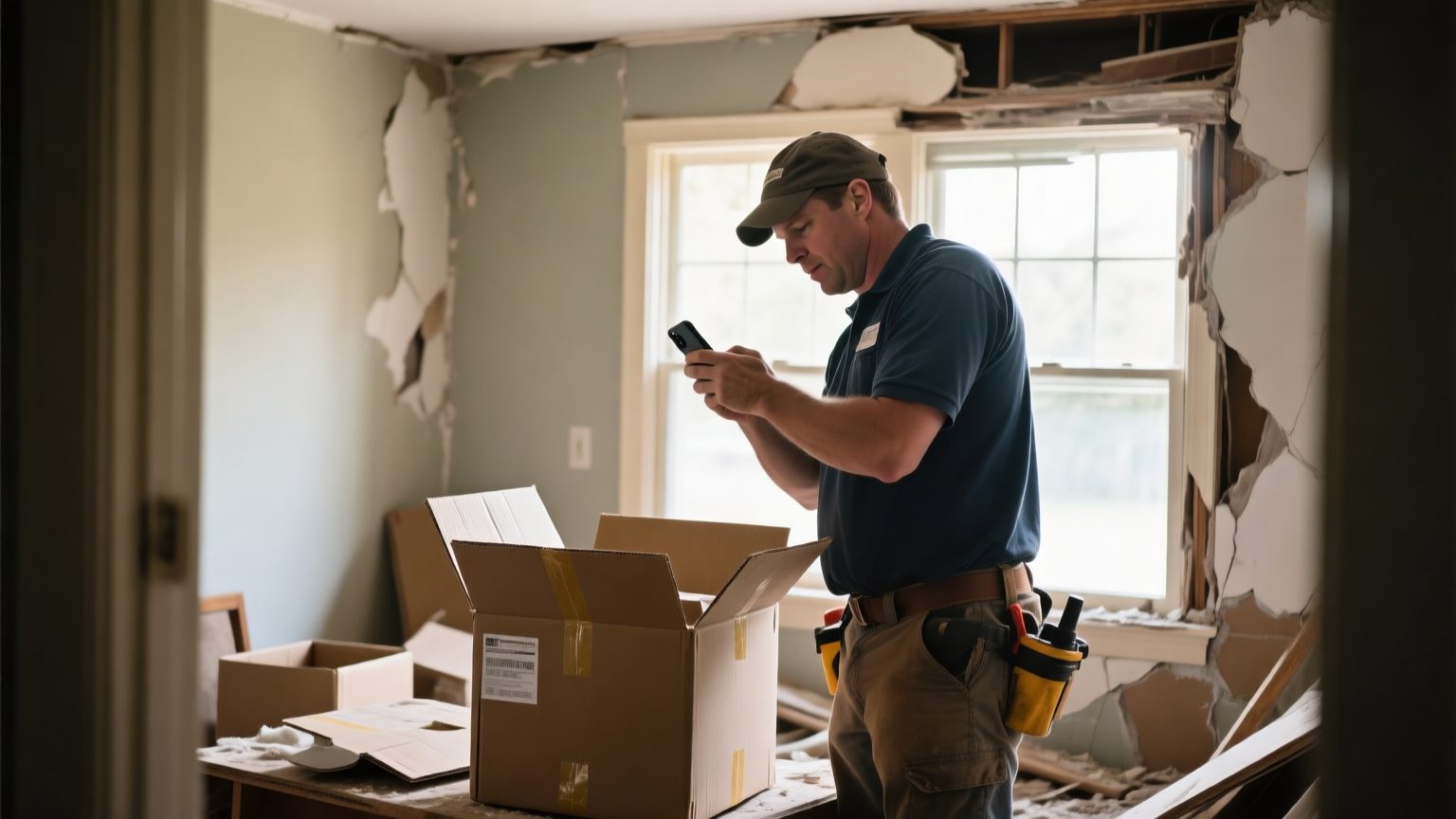
The valuation happens at a desk, but the evidence is made in the field. By the time a contents inventory reaches a carrier reviewer, the items are boxed, cleaned, or gone, and the only record of what they were and what shape they were in is what the crew captured during packout. Get that capture right and every replacement cost value has something behind it. Get it wrong and even accurate values look unsupported. This is what to capture on the way out the door.
Why the packout is where the contents file is won or lost
Contents documentation has one hard constraint that room and structure work do not: the subject leaves. Once an item is packed out, disposed of as non-restorable, or replaced, you cannot go back and photograph the wear on the couch cushion or read the model number off the back of the television. The packout is the single moment when the physical item and the person documenting it are in the same place. Restoration crews already handle that moment. The opportunity is to capture a little more, deliberately, so the valuation built later stands on evidence instead of memory.
This is complementary work, not extra process for its own sake. The crew is already touching, moving, and photographing each item. Capturing the right fields at that step is what turns a packout into a review-ready contents file, and it is why contents valuation fits alongside a restoration packout rather than competing with it.
The five things to capture on every item
A defensible line item answers five questions a reviewer will ask. Capture these at packout and the rest of the file assembles cleanly.
| Capture at packout | Why the reviewer needs it | If it is missing |
|---|---|---|
| Item identity: brand, model, size, material | Sets the replacement cost value and the like kind and quality match | The value defaults to a generic guess that is easy to question |
| Condition and observed damage | Supports the restorable-versus-replace call and the depreciation for wear | Depreciation and disposition become opinions with no record |
| Age indicators: purchase clues, wear, dates | Feeds the actual cash value calculation fairly | Age is estimated late, often to the claimant's disadvantage |
| Quantity and grouping | Keeps counts accurate on high-volume inventories | Bundled or miscounted items drift the total |
| Room and location, tied to a photo | Places the item in the loss and connects it to the evidence | The line floats free of any proof it existed |
Identity is the field crews most often shorten under time pressure, and it is the one that carries the most weight. "Sofa" prices differently than "three-seat leather reclining sofa," and the difference in the replacement cost value is real. A few extra seconds reading a label at packout is worth more than an hour of research afterward. For how those fields flow into the numbers, see how replacement cost value works on a contents claim.
Photograph the item like it is leaving forever
Because it is. Treat every packout photo as the last one anyone will take of that item. That means more than a single wide shot of a room. Capture the item itself, a close frame on the brand or model marking, and a clear frame on the damage or wear. Note pre-existing damage as its own frame so nothing gets attributed to the loss that was already there. Consistent, well-lit photos are the backbone of a claim, a point the field guidance on photo documentation that gets claims approved faster makes plainly. For fire and smoke losses, where residue and heat damage need to be visible, the room-by-room approach in how to document contents after a fire applies directly at packout.
Record the disposition call, not just the item
Restoration teams decide what can be cleaned and returned and what has to be replaced. That restorable-versus-non-restorable judgment belongs in the contents record, with a short reason. "Non-restorable, heat-warped" or "restorable, laundering" tells a reviewer why the item is valued the way it is. The professional standards that govern contents processing, published by the IICRC, treat that disposition decision as a documented step, not an afterthought. Capturing the reason at packout, while the item is in hand, is far more credible than reconstructing it from a photo weeks later.
Keep it consistent across crews and protect the data
On a large loss with several crews, the risk is not one bad line, it is drift: one crew records model numbers, another writes "misc kitchen," and the file reads as two different standards. Agree on the capture fields before the trucks roll, and use the same intake for everyone. Consistent input is what lets the file be reviewed as one document. It also matters for the same reason the wider claim process does; the general expectations for a homeowners contents claim, laid out by the Insurance Information Institute, assume a complete and orderly inventory. Because the capture includes photos and claim details, handle that data carefully; how Contensure handles security covers the storage and access side so the evidence stays protected.
Where Contensure fits
Contensure takes what the crew captured at packout, the photos, item notes, and lists, and turns it into review-ready replacement cost values with the evidence attached: item descriptions, comparable retail pricing, and the source behind each value. It drafts the valuation and documentation in a fraction of the manual time, and your team reviews and signs off before anything is final. It complements the packout and the restoration workflow rather than replacing them, and it is not a public adjuster. The field capture stays with the professionals who do it best; the research, valuation, and file assembly is what the AI accelerates. Age and condition captured at packout flow straight into a fair calculation, which is the same discipline described in documenting contents age and condition so depreciation is applied fairly. More guidance for contents professionals is on the Contensure blog, and teams that want to see it on their own claims can talk to Contensure or start on the Contensure platform.